"Grandma, It's Me — I'm in Trouble": The Grandparent Scam and How to Stop It
The voice on the phone is your grandson's. The panic is real. The crack in his voice is real. But it is a machine — built from a few seconds of a video online.
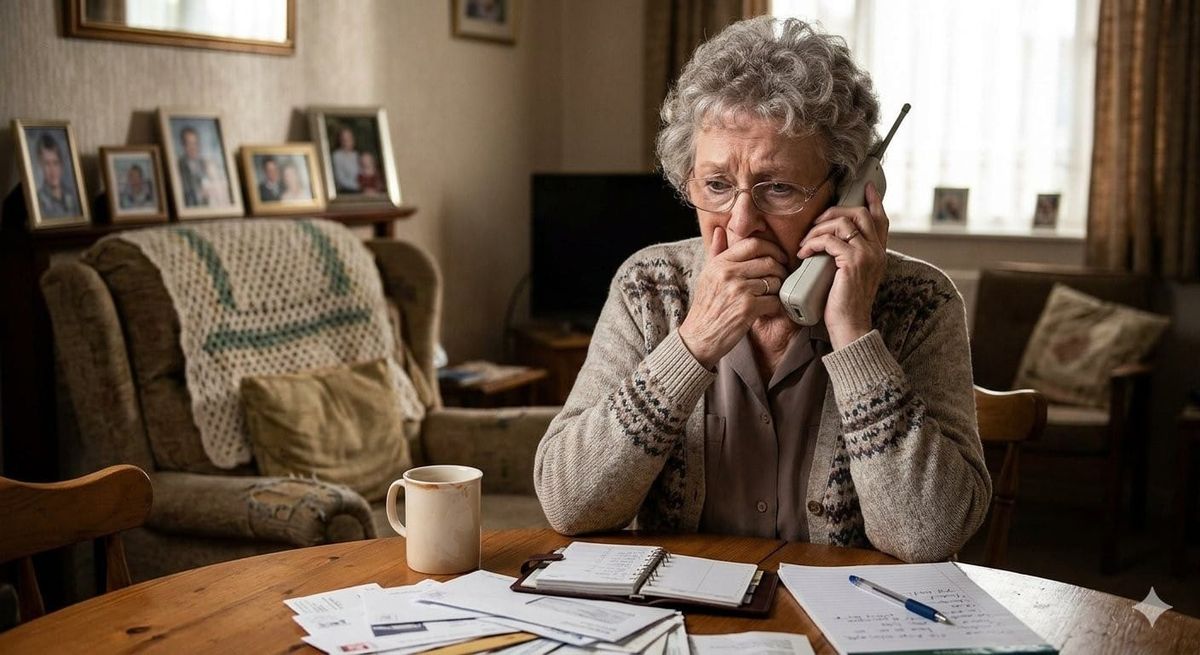
It's a little after nine on a Tuesday morning when the phone rings. The woman who answers — we'll call her Eleanor, 74, though her story is stitched together from thousands of real ones — hears a young man's voice, panicked and crying.
"Grandma? Grandma, it's me. I'm in trouble. Please don't be mad."
The voice is muffled, shaky. Eleanor's heart drops. "David? Honey, what's wrong?"
"I was in a car accident. There was a woman in the other car — she was pregnant, Grandma, and she lost the baby. They arrested me. I'm so scared. Please don't tell Mom and Dad, they'll never forgive me."
A second man comes on the line. He says he's David's attorney. The bail is $9,000, in cash. A "court courier" will come to her home this afternoon to collect it. And whatever she does, she must not discuss the case with anyone — there's a gag order, and talking could put David in more danger.
Eleanor goes to the bank. She withdraws the money. By two o'clock, a polite young man in a collared shirt is at her door with a clipboard and an official-looking receipt. He takes the envelope and leaves.
David, of course, was never in an accident. He was at work the whole time, an hour away, with no idea his grandmother had just handed $9,000 to a stranger.
How the scam actually works
The "grandparent scam" is a type of imposter scam, and it follows a script that has been refined over years to do one thing: flood you with so much fear that you act before you think.
Every version uses the same three levers. Urgency — someone you love is in danger right now. Secrecy — you're told not to call other family members, often under the guise of embarrassment or a legal gag order. And an untraceable payment — cash handed to a courier, a wire transfer, gift cards, or cryptocurrency, all chosen because they're nearly impossible to claw back.
What most people don't realize is how organized this has become. These are rarely lone callers. They are often professional criminal operations with call centers, scripts, "dispatchers," and a network of couriers sent to victims' doors.
This is not rare, and it is not small
In 2024, imposter scams were the single largest category of fraud reported to the Federal Trade Commission — 845,806 reports and roughly $2.95 billion in losses. Adults 60 and older were hit especially hard, reporting about $700 million lost to imposter scams in a single year. That's more than five times what older adults lost to the same scams in 2020.
And the grandparent scam specifically? In April 2024, federal prosecutors charged sixteen people in connection with a transnational "grandparent scam" run out of the Dominican Republic. According to the Department of Justice, the ring impersonated grandchildren in distress — claiming, in some calls, that they'd been arrested after a car accident involving a pregnant woman — and demanded cash for bail or a lawyer. Call-center dispatchers managed U.S.-based couriers who drove to elderly victims' homes to collect the money, often using fake names and handing over fake receipts. Between May and December of 2023 alone, those couriers moved more than $55 million in cash and precious metals.
Months later, in November 2024, two more couriers were charged after collecting roughly $230,000 from victims across more than a dozen communities in just a few weeks.
The scenario at the top of this article isn't an exaggeration. It's the playbook.
The newest danger: your grandchild's actual voice
For years, the weak point in this scam was the voice. A frightened grandparent might think, that doesn't quite sound like David. Criminals leaned on bad phone connections and crying to cover the difference.
That weak point is disappearing. Scammers now use artificial intelligence to "clone" a person's voice from just a few seconds of audio — a video posted on social media, a voicemail greeting, a clip from anywhere online. The Federal Trade Commission has warned that fraudsters are using these tools to make family-emergency scams more convincing than ever. The voice on the line may not merely sound like your grandchild. It may be indistinguishable from your grandchild.
This is why the old advice — "you'll be able to tell it's not really them" — is no longer enough. You cannot trust your ears alone anymore.
How to protect yourself and the people you love
The good news is that the defense is simple, and it doesn't require understanding any technology. It requires one habit: stop, and verify.
Hang up and call back on a number you already have. No matter how real the call feels, tell the caller, "I'm going to hang up and call you right back." Then call your grandchild — or their parent — on the phone number you already know. If it was your grandchild, they'll answer, safe and confused. If it was a scammer, the real person will pick up and the spell is broken. A genuine emergency survives a five-minute phone call. A scam does not.
Create a family "safe word." Agree, ahead of time, on a private word or phrase known only to your family. If someone calls claiming to be a relative in trouble, ask for the safe word. A scammer — even one using a perfect AI voice — won't know it.
Treat the payment method as the biggest red flag of all. No legitimate court, lawyer, hospital, or police department will ever send a courier to your home for cash, or ask to be paid in gift cards, wire transfers, or cryptocurrency. That request, by itself, is proof you're being scammed. Full stop.
Refuse the pressure to keep it secret. "Don't tell Mom" is not how real emergencies work — it's how scams work. The secrecy exists for one reason: to keep you from making the one phone call that would expose the lie. Always tell another family member.
Slow everything down. Scammers manufacture urgency on purpose, because panic is the enemy of clear thinking. You are allowed to take your time. You are allowed to ask questions. You are allowed to say, "I need to check on this first" and hang up.
If it has already happened
If you or someone you love has fallen for this, please hear this clearly: it is not your fault. These are professional criminals running a script designed by experts to overwhelm caring, loving people. Being targeted means you love your family — that's exactly the instinct they exploit.
Act quickly, because fast action sometimes helps:
- Call your bank or wire-transfer company immediately to try to stop or reverse the payment.
-
- Report it to the FTC at ReportFraud.ftc.gov.
-
- Report it to the FBI's Internet Crime Complaint Center at IC3.gov.
-
- Call your local police, especially if a courier came to your home — that detail can help investigators.
Reporting matters even when the money can't be recovered. It's how these rings get traced, charged, and shut down — like the sixteen people the Justice Department brought charges against in 2024.
The one sentence worth remembering
If a phone call ever tells you that someone you love is in trouble, needs money immediately, and that you mustn't tell anyone else — hang up and call them back on a number you already have.
That single habit defeats this scam every time, no matter how frightening the call, and no matter how real the voice.