The Fake Airline Number: The Thanksgiving Travel Scam That Starts With a Search
She searched online for her airline's customer service number, and a scammer answered. Before Thanksgiving travel, here is how the fake airline number trap works, the one rule that stops it, and what to do if you already paid. The rule: never call an airline number you found in a search.
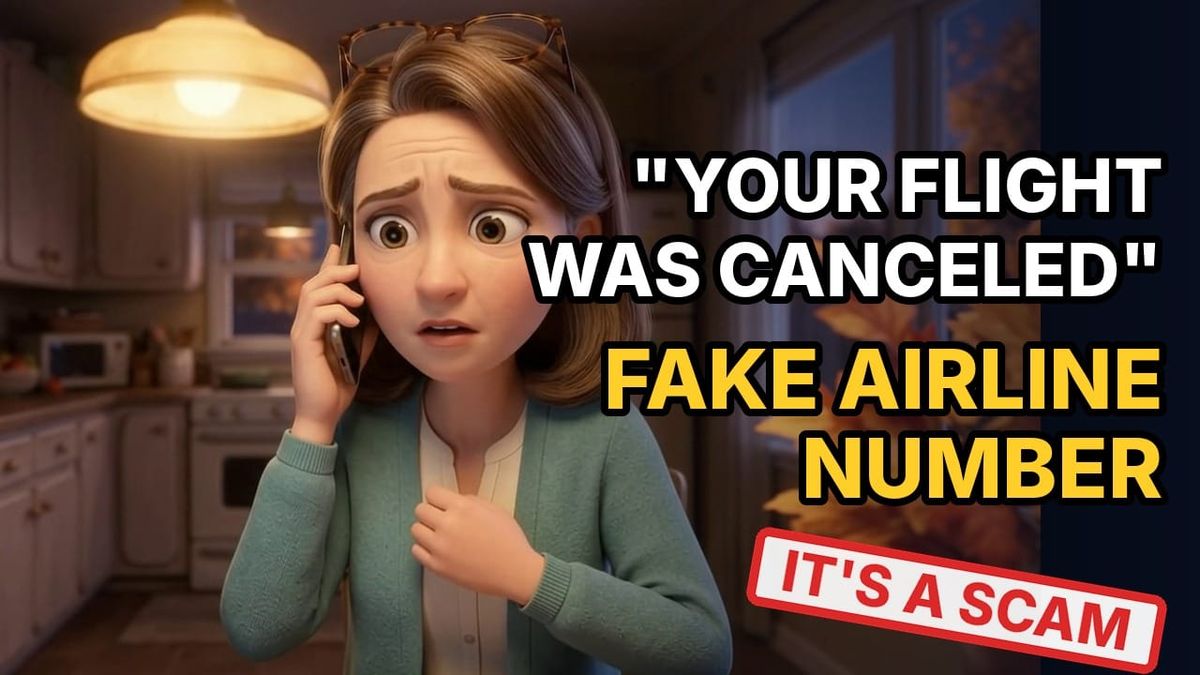
A call to check her seats
She and her husband were planning a trip to Portugal for their 25th wedding anniversary. The flights were booked and paid for. She only wanted to check their seats.
So she searched online for the airline's customer service number. She called it, and someone answered right away. The person who answered was a scammer. He asked for her confirmation code. Then he said a computer glitch had canceled their flight, and that an outside travel agency would rebook them at a discount.
Emails arrived with the airline's logo on them. Everything looked real. So she paid again, nearly $15,000, for a trip they had already bought.
The real airline later confirmed it was a scam. Their flight had never been canceled. The number she found in a search was the trap.
Why this matters this Thanksgiving
On November 13, more than 12,000 flights were canceled across the country in a single day. When real flights are canceled, worried travelers search for help. And more than 80 million Americans are expected to travel for Thanksgiving. Scammers know it.
The safe move: never call an airline number you found in a search. Use the number in the airline's app or in the email you got when you first booked, not an email that came after a problem.
How the trap works
These are the scammer's steps, so you can recognize them. They are not instructions to follow.
1. The fake number. You need help, so you search online for the airline's number. That is where the trap is set. The number at the top may belong to a scammer. It can be a paid ad, or a page on a hacked website.
2. The fake agent. The scammer answers fast and sounds friendly. He or she asks for your confirmation code. Then the scammer invents a problem: your flight was canceled, or you owe a fee.
3. The payment. The scammer asks for your card number, may email you a form to sign so they can charge your card, or moves you to a so-called partner company that takes your money. If any of this happens to you, hang up. Then call the airline using the number in its app or your original booking email.
The new twist
In October 2026, a news investigation found fake airline and travel numbers hidden on hacked university and government websites. When the reporter searched, some of these numbers even showed up in A.I. search answers.
In a separate case, a woman was arranging flight changes for six people in their seventies and eighties. She called a number from her search results. The fake agent emailed her a form. Moments after she signed it, someone tried to charge $4,500. Her card company flagged the charge, and it never went through.
If you are on the phone with a number you found in a search, hang up. Then call the airline using the number in its app or your original booking email. If you gave your card number or paid, call your card company or bank right away, using the number on the back of your card. See "What to do" below.
Things to remember
- The top search result, even an A.I. answer, can be a scammer's number.
- If someone you reached through a search, a text, an email, or a call you did not expect says your flight was canceled, asks for a fee or your card number, wants you to pay a different company, or sends you a form to sign, hang up. Then call the airline yourself, using the number in the airline's app or in your original booking email. Never use a number from a search.
- A text or email that says your flight was canceled and gives you a number to call or a link to tap can also be a scam. Do not call the number or tap the link. Check your flight in the airline's app, or call the airline's number you saved.
What to do
Before you travel: Save the airline's real number in your phone. Get it from the airline's app (download it only from your phone's official app store), or from the email you got when you first booked, before any problem came up. (If you booked through a travel agent or a booking website, the number in the first booking email from them is also safe. A travel agency or "partner company" you did not book with is not, even if someone says the airline sent them.) Do not get it from a search, and that includes a number on a website you reached by clicking a search result. No app, and can't find that first email? Look for the number on a boarding pass or printed itinerary from your original booking, not on anything sent after a problem came up, or ask a family member to help you get it from the airline's app. At the airport, the airline's own desk is also safe.
If you reached someone through a number from a search, a text, an email, or a call you did not expect: hang up, even if they sound helpful, and especially if they say your flight was canceled, ask for a fee, or want you to pay another company or sign a form. Do not give that person your card number or your confirmation code. If they call back, do not answer. Then check your flight yourself, using the number you saved, the airline's app, or your original booking email. It is fine to give your confirmation code to the airline when you call it that way.
If you already paid, or gave your card number or confirmation code: (If you gave only your confirmation code, start with step 3.)
- Call your card company or bank right away, using the number on the back of your card or on your statement. If you paid another way, call right away, as follows. For a wire or Zelle, call your own bank, using the number on your card or statement. For gift cards, call the company named on the card, using the number on the back of the card or on your receipt. Do not search online for these numbers.
- Dispute the charge, even if you signed the scammer's form. If you paid by card, ask for a new card. If the bank says no, ask for a review. Keep every email, receipt and the phone number you called.
- Contact the real airline, using the number you saved or the one in its app, to protect your booking.
- Report it to the Federal Trade Commission at ReportFraud.ftc.gov and to the FBI at ic3.gov. If you are 60 or older, call the National Elder Fraud Hotline at 1-833-372-8311. Anyone can call the AARP Fraud Watch Network Helpline at 877-908-3360. Both are free.
- Anyone who contacts you offering to get your money back is likely another scammer, even if they say they are from the FTC, the FBI, a bank or a law firm. Never pay a fee to get money back.
It is not your fault. These criminals do this for a living.
What happened to her
She disputed the charge with her bank. About two months later, she says, the bank turned her down. She did not give up. She asked a television consumer team for help. After the reporters contacted the company that took her money, it refunded $14,704. She spent 60 to 80 hours getting her money back.
Do not contact the scammers yourself. Let your bank, the authorities, or a consumer reporter do that.
If your parents or grandparents are flying
Before they leave for Thanksgiving, save the airline's real number in their phone, taken from the airline's app or their original booking email. Tell them: never call an airline number found in a search, and at the airport, go to the airline's own desk. If anyone says their flight is canceled or asks them to pay, they should hang up and call you or the saved number before doing anything. Then share this article or the video with anyone traveling this Thanksgiving.
Where to get help
Hang up first. Never call back a number the caller gave you or a number you found in a search. The numbers below are official and safe to call.
- If you are in danger right now: call 911.
- If you paid or gave your card number: call your card company or bank right away, using the number on the back of your card or on your statement.
- National Elder Fraud Hotline: 1-833-372-8311 (1-833-FRAUD-11), Monday–Friday, 10am–6pm ET, for adults 60 and older
- AARP Fraud Watch Network Helpline: 877-908-3360, Monday–Friday, 8am–8pm ET, free for everyone
- Federal Trade Commission: ReportFraud.ftc.gov or 1-877-382-4357 (1-877-FTC-HELP)
- FBI Internet Crime Complaint Center: ic3.gov
- Your local police: visit your local police station to make a report. Do not search online for a police number. If you are in danger right now, call 911.
- Your state attorney general: ask the AARP helpline or the National Elder Fraud Hotline to connect you with your state's consumer protection office.
The rule
Never call an airline number you found in a search. Use the airline's app, your original booking email, or the airline's desk at the airport.
Sources: Federal Aviation Administration statement on the November 13, 2026 ground stop and flight cancellations (November 15, 2026); AAA 2026 Thanksgiving travel forecast; Federal Trade Commission consumer guidance on airline customer service impostors; published accounts of the California case (November 2026) and of the October 2026 investigation into fake travel numbers on hacked websites.
Educational, not legal or financial advice.