"I'm Calling From Your Pharmacy": The Medicare Enrollment Scam That Signed Up 300 People in One Day
Federal rules forbid Medicare plans from calling you out of the blue. One insurer did it anyway, using pharmacy records — and admitted it to the Justice Department.
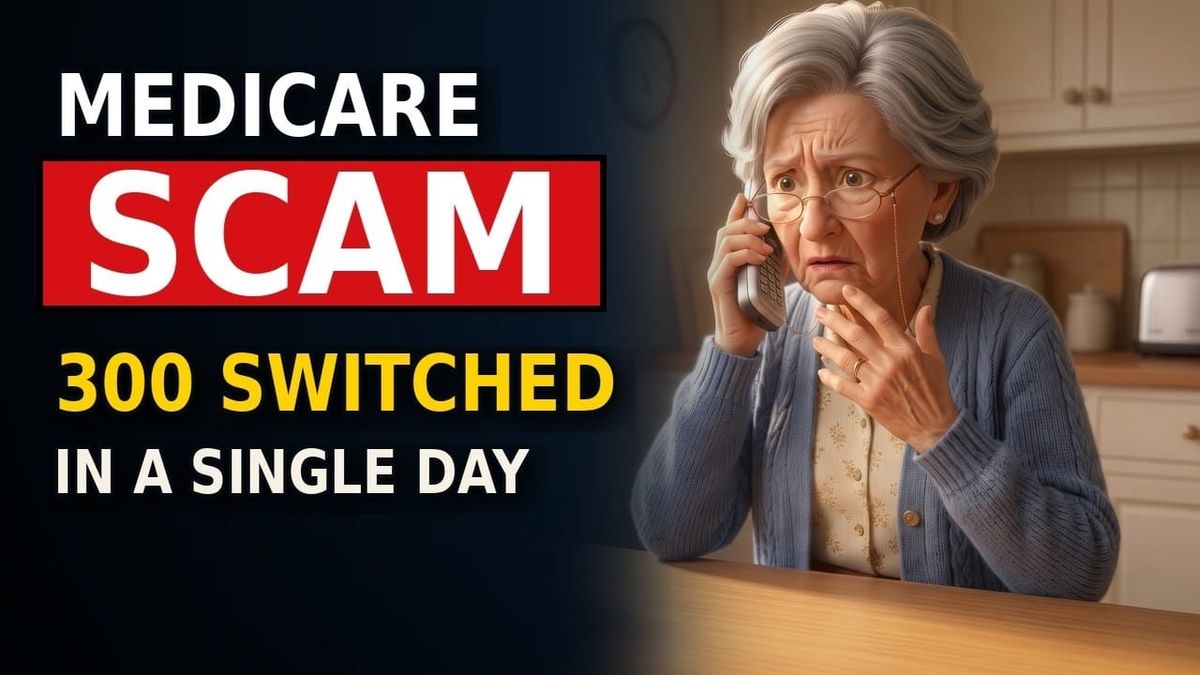
Prefer to watch? The full 7:44 version is above — the two exceptions, the five warning signs, and the four numbers to call.
The call did not sound like a scam. It sounded like the pharmacy.
The voice knew the name, the address, the date of birth and the Medicare number — it was reading them off a screen. And the offer was not a hard sell. It was reassurance: this is a supplement to what you already have. Nothing goes away. You just get a little more.
None of that was true. The caller did not work for the pharmacy, and the plan was not a supplement — it was a replacement. In the first three months of 2022 that operation enrolled more than 2,700 new Medicare Advantage members, and on a single day that March it enrolled more than 300 people, roughly one every minute, many in automatic batches.
If you are on Medicare, or you are the adult child of somebody who is, this is the season that call comes. Open Enrollment runs October 15 through December 7, and the calls, texts and mail start before it opens. The company was a real, licensed North Carolina insurer called Troy Health. In August 2025 it signed a non-prosecution agreement with the Justice Department and admitted that beneficiaries had been enrolled without their knowledge or consent, paying a criminal penalty of $1,430,008. Its sales staff had used software to pull the names and Medicare numbers out of pharmacy records in the first place. The department did not say all 2,700 enrollments were fraudulent; it said people were enrolled without knowing, and that the company admitted it.
The reason it matters is not the fine. It is that nothing about the call would have felt wrong.
The scale
Government impersonation is one of the largest and fastest-growing categories of fraud in the country, and it lands disproportionately on older adults. The FBI's Internet Crime Complaint Center recorded 8,628 government-impersonation complaints from people aged 60 and over in 2025, with losses of $413,206,251 — more than half of all reported government-impersonation losses that year, from one age group. That same report put total losses among people 60 and over at $7.748 billion, a 59% increase over 2024. The Federal Trade Commission, counting separately, logged about $920 million lost to government impersonators in 2025, up from $866 million.
Why the uninvited call is the warning sign
Most fraud advice asks you to judge the content of a call. This rule does not, because federal regulation already drew the line. Under 42 CFR §422.2264, Medicare Advantage organizations and their agents and brokers may not approach you unsolicited, and the regulation is unusually specific: no door-to-door solicitation, no approaching people in parking lots, hallways or lobbies, no direct messages from social media platforms, no cold calls, robocalls, texts or voicemails. It then closes the side doors — a call because somebody referred you, a call to a former member, and a call merely to confirm you received a mailing are all prohibited.
There are two exceptions, and most scam advice only tells you about the first.
One: a call is not unsolicited if you started it. If you telephoned the plan, or returned a business reply card requesting contact, a call back is permitted.
Two: a plan you are already enrolled in may call you. Under §422.2264(b) a plan can contact its current members about plan business, including other Medicare products it sells. CMS's booklet puts it plainly: a plan cannot "call you, unless you're already a member of the plan. If you're a member, the agent who helped you join can call you." Your plan must also tell you in writing once a year that you can opt out.
Medicare itself is the same story. On the page about your Medicare card: "Medicare will never call you uninvited and ask you to give us personal or private information." On the page about reporting fraud: "Remember that Medicare will never call you to sell you anything or visit you at your home." But that same fraud page says Medicare "will only call and ask for personal information in limited situations" — an agent returning your call after you joined a plan, reported fraud, or left a message.
So the sharper test is not did the phone ring. It is: your own plan already has your Medicare number. It has no reason to ask for it.
Two things this rule does not say, both of which are commonly gotten wrong:
An unsolicited mailer is legal. The same regulation that bans the cold call expressly permits print advertising, direct mail and email — the email "provided every email contains an opt-out option." Writing to you is allowed, so the envelope itself proves nothing. What it asks you to do is the evidence.
A new Medicare card is not automatically a scam. For eight years the standard advice was that anyone mentioning a new card was a criminal. That stopped being reliable this year: in March and April 2026 Medicare issued new numbers and mailed new cards to some beneficiaries, with a letter explaining why, as the Senior Medicare Patrol confirms on its own site. An unannounced card with a letter is not what should worry you. A voice on the phone asking you to confirm the digits is.
The five warning signs
Every one is about how the contact reached you, not what was said inside it.
- The call came to you, and you are not already this plan's member. You did not dial, return a card, or ask to be contacted.
- Somebody said the word "free." A brace, a genetic test, a kit in the mail, at no cost — and the only thing required is your Medicare number, for their records. CMS puts it in writing: "Never give your Medicare Number in exchange for free medical equipment or any other free offer. Dishonest providers will use your numbers to get payment for services they never delivered."
- They already know things about you. The pharmacy you use, your date of birth, the name of your physician. None of that establishes who is calling; it establishes that somebody sold your file — which is precisely what happened at Troy Health.
- There is a deadline inside the phone call. December 7 is published and fixed. A cut-off that exists only for the duration of the call is not a deadline, it is a technique.
- The caller ID agrees with the caller. This is the one that catches careful people, because it is the only physical evidence in front of them. The FTC: "Don't rely on your caller ID. It might show Medicare's name or phone number, but caller ID can be faked." Worse, the HHS Office of Inspector General has warned that scammers now spoof its own hotline numbers.
What it costs, and how to undo it
Being switched into the wrong plan is not an abstraction. A Medicare Advantage plan has a network, and non-emergency care from a doctor outside it may cost more or may not be covered. Drug coverage runs on the plan's own list and preferred pharmacies. The default rule is that you keep the plan for the calendar year — and if a provider leaves the network mid-year, you generally cannot change plans in response.
But an enrollment obtained by misrepresentation is a different situation, and Medicare has a specific route for it.
If a plan representative misled you, or you were signed up without your knowledge, you may qualify for a Special Enrollment Period. It is not something you simply claim: the regulation says this SEP "requires CMS approval prior to use," and you must demonstrate to CMS what happened. Where CMS agrees, it can approve a disenrollment that reaches backwards — retroactive disenrollment is authorized case by case for fraudulent enrollment and misleading marketing. It does not happen through a web form. It happens on the telephone, and the wording matters: I believe I was enrolled without my consent, or I believe I was misled.
A second route runs on the calendar. Anyone already in a Medicare Advantage plan gets a window from January 1 through March 31 to make one change — to a different Advantage plan, or back to Original Medicare. If you go back, join a stand-alone drug plan in that same window, or you can be left with no drug coverage and a lifelong late penalty. One change only, and it shuts on March 31.
One habit worth building either way: a free Medicare account online shows a claim usually within 24 hours of processing, while the paper Medicare Summary Notice arrives only every six months, and only if there was activity. The mail is not an early warning system. The account is.
If this is happening to you right now
Medicare — 1-800-633-4227 (TTY 1-877-486-2048). Open 24 hours a day, seven days a week, except some federal holidays. Call if you think you were enrolled without your consent, or that a plan or agent misled you.
Senior Medicare Patrol — 1-877-808-2468, smpresource.org. Federally funded, one in every state, nothing to pay. Helping people detect and report exactly this is why it exists.
HHS Office of Inspector General — 1-800-447-8477, oig.hhs.gov/fraud/report-fraud. For billing fraud and stolen Medicare numbers.
State Health Insurance Assistance Program — shiphelp.org. Free, unbiased help comparing plans, from someone not selling one.
Report it at ReportFraud.ftc.gov.
The rule worth saying out loud at a kitchen table before October 15: your own plan already has your Medicare number. If somebody calls and asks you to give it to them, they are not who they say they are — whatever the caller ID says. Hang up, and call the number yourself.
Sources: Medicare.gov, "Your Medicare Card" and "Reporting Medicare fraud & abuse." 42 CFR §422.2264, Beneficiary contact. Medicare & You 2026, U.S. Centers for Medicare & Medicaid Services. "Protecting Yourself From Fraud," CMS Publication No. 10111, revised February 2025. Medicare Advantage and Part D Enrollment and Disenrollment Guidance, CMS. U.S. Department of Justice, "Troy Health, Inc. Enters Non-Prosecution Agreement and Admits Fraudulently Enrolling Medicare Beneficiaries," August 20, 2025. U.S. Department of Justice, "United States Files False Claims Act Complaint Against Three National Health Insurance Companies," May 1, 2025. FBI Internet Crime Complaint Center, 2025 Internet Crime Report, released April 2026. Federal Trade Commission, 2025 Consumer Sentinel data, June 2026, and consumer alert, September 30, 2025. Senior Medicare Patrol, smpresource.org.