“This Is the FBI”: The Call That Cost a Couple $25,000, and the One Rule That Stops It
Scammers now borrow real agents' names and fake the caller ID of real federal offices. Here is how the fake-agent trap works, the FBI's latest numbers, and exactly what to do if the call comes.
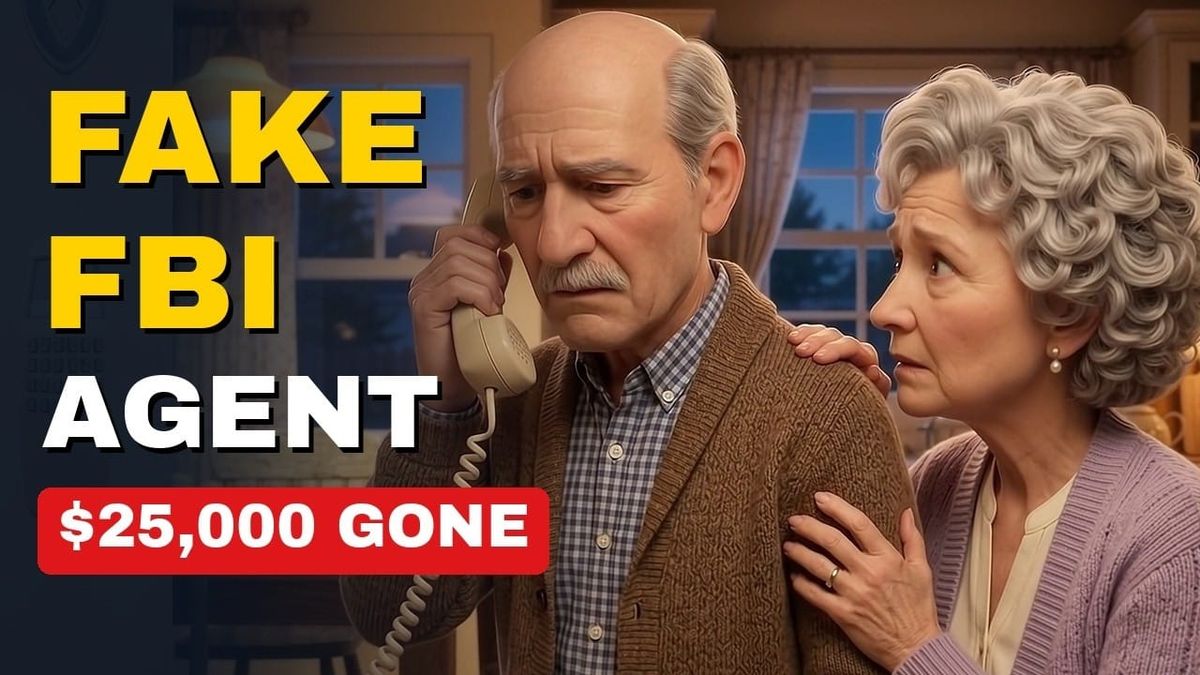
In August 2025, a phone call reached an older couple in North Texas. He was 80. His wife was 77.
The caller claimed to be from their bank, and from the FBI. Over several hours, the caller talked them into taking more than $25,000 out of their account, in cash. Then they were told where to bring it: a remote parking lot.
A young woman was waiting there. She said she was an FBI agent. They handed her the money.
There was no case. There was no agent.
The FBI's warning, and the new tricks
On September 17, 2026, the FBI repeated its warning about callers who pretend to be police, federal agents or government officials.
The calls are getting harder to see through. In late September, the FBI's Newark office described three new tricks reported in New Jersey:
- Real agent names. Callers use the names of actual federal agents, so a quick search "checks out."
- Spoofed office numbers. The caller ID shows the number of a real federal office.
- A fake FBI office on video. One scammer staged a video call in front of a fake FBI office: a desk, an FBI seal, a man in a suit.
How the trap works
Step one: the accusation. You are told your identity has been tied to a crime. According to the FBI, most complaints involve threats of arrest, prosecution or prison, unless you pay or help catch the "real" criminals.
Step two: the proof. The number on your phone looks right. The agent's name checks out, because a real agent by that name exists. There may even be a video call from what looks like a federal office. Every piece is there to make you stop doubting.
Step three: the secret. You are told to stay on the line. You are told not to tell your family, your friends, your bank or the police. Then comes the money, "to protect it": a bank wire, prepaid cards, cash fed into a cryptocurrency machine, or cash handed to a courier.
How often it happens
Between January 2025 and July 2026, the FBI received nearly 61,000 complaints about these impersonation scams. Reported losses: more than $1.6 billion.
That counts only the people who reported it.
Three facts to keep by the phone
- Police and government agencies will never call or text you to demand any kind of payment, or to ask for your personal information.
- They will never ask you to pay with prepaid cards, cryptocurrency or a courier.
- The number on your screen proves nothing. It can be faked. A real name proves nothing either; scammers borrow the names of real agents.
If the call comes
- Hang up. Do not call back any number the caller gave you.
- Look up that agency's number yourself, on its own official website. For the FBI, that is its toll-free line, 1-800-CALL-FBI (1-800-225-5324), or your local FBI field office, listed at fbi.gov/contact-us/field-offices. Tell whoever answers that you think someone may be pretending to be an agent, and ask whether a real agent is trying to reach you.
- If it was a video call, the FBI says to take a photo of the screen first. Then hang up and send the photo to the FBI at tips.fbi.gov.
- If money has already gone out, call your bank right away. Then report it to the FBI's Internet Crime Complaint Center at ic3.gov, and to your local police.
What happened to the couple
Once they realized what had happened, they called the police. Two weeks later, officers arrested a 22-year-old woman. Police say she was the woman in the parking lot. They believe others may have been involved.
If you have a parent over 60
Call them this week. One of the scammer's key instructions is: do not tell your family. So make your family the first call.
Agree on one sentence: "If anyone official ever calls about trouble, you call me before you do anything."
Where to get help — all free
- FBI: 1-800-CALL-FBI (1-800-225-5324) · tips.fbi.gov
- Your local FBI field office: fbi.gov/contact-us/field-offices
- FBI Internet Crime Complaint Center: ic3.gov (type the address in yourself)
- National Elder Fraud Hotline (for anyone 60 or older): 1-833-372-8311 (1-833-FRAUD-11), Monday to Friday, 10 a.m. to 6 p.m. Eastern
- Federal Trade Commission: ReportFraud.ftc.gov
If this has happened to you or someone you love, you are not alone. These are organized criminals, and they are very good at sounding official.
The rule worth keeping
No real agent will ever call or text you to demand money. No real agent will ever send someone to collect it. If someone official calls about trouble, you hang up, and you make the call.
Sources: FBI Internet Crime Complaint Center, public service announcement I-091726-PSA, September 17, 2026 (complaint and loss figures, January 2025 to July 2026; payment methods; agencies never demand payment). FBI Newark release, September 29, 2026 (real agents' names, spoofed office numbers, staged FBI-office video call; photograph the video call and submit to tips.fbi.gov; 1-800-CALL-FBI). U.S. Attorney's Office, District of Kansas, December 23, 2025. FBI contact and field-office pages. U.S. Department of Justice, Office for Victims of Crime (National Elder Fraud Hotline). The couple's story comes from a Texas police department's August 2025 announcement as reported by local news; names are left out here. Checked October 2026. This article is educational and is not legal or financial advice.