Medicare Said She Was In Hospice. She Wasn't.
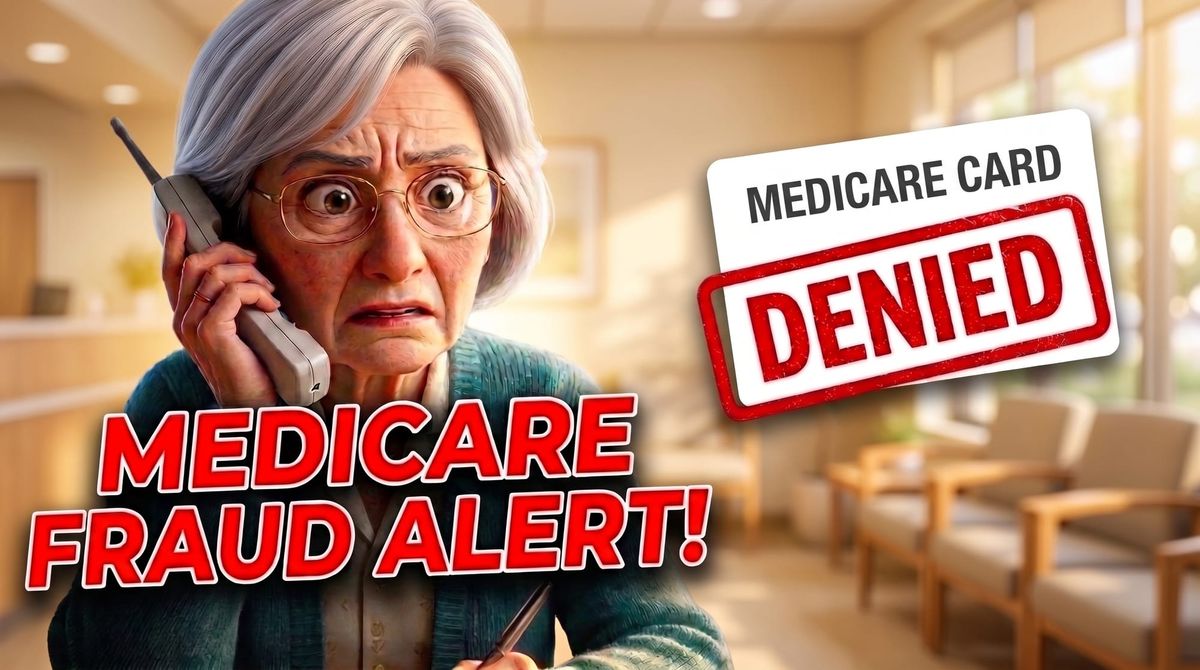
Nobody took a dollar out of her bank account. What they took was her Medicare number — and for six months, that was worse.
She hurt her shoulder playing pickleball.
Her doctor sent her to physical therapy twice a week, and Medicare paid for it, the way Medicare is supposed to. Then she came in for her last appointment, and the front desk called her over.
Medicare had denied the claim.
The reason on the screen made no sense at all. According to Medicare's records, she was enrolled in hospice care.
She laughed. So did the woman at the desk. It was so obviously a clerical error that somebody would fix it in an afternoon.
Nobody fixed it.
She spent hours on hold and filed an appeal she never heard back about. One Medicare representative suggested she hire a lawyer, and warned her it could take a year or two. All that time she kept paying her premiums and could not get medical care of any kind — because in the eyes of the system, she was a dying woman who had chosen to stop treatment.
So she looked into it herself. The hospice's address was a strip mall. Its phone went unanswered. The doctor named on her file was a surgeon who had never heard of her; his identity had been stolen too.
Six months later a new Medicare card arrived in the mail, with no letter and no explanation.
That is not a cautionary tale. That is testimony, given to a committee of Congress this year.
Why a Medicare number is worth more than a credit card
Most of us picture fraud as money leaving an account. This is not that.
A credit card can be cancelled in a single phone call. A Medicare number follows you. It is attached to your medical record, your eligibility, and your history of care — and when someone else uses it, the damage does not show up as a missing balance. It shows up as a denial, months later, at the moment you actually need something.
The scale is not small. In June 2025 the Justice Department announced charges in a scheme that had billed Medicare $10.6 billion for catheters and medical equipment, using the stolen identities of more than a million Americans across all fifty states. A year later, in June 2026, they announced $3.7 billion more.
Almost none of those people lost money directly. What they lost was the clean record that lets a claim go through.
It rarely looks like a crime
In Maryland, a woman received three back braces she had never ordered. One of them was billed to Medicare at over $1,100. Medicare paid about $400 for it. The same brace sells online for around twenty-five dollars.
She did not lose a cent. Her Medicare did.
And the numbers themselves are merchandise. In a case brought in South Florida in June 2026, an employee of a health network photographed patient records off his own screen. Roughly a hundred numbers sold for about five hundred dollars. Downstream, individual numbers resold for as much as seven thousand dollars each.
That is the market your number sits in the moment it leaves a building.
Five signs the call is not really Medicare
Every one of these is about the shape of the contact, not the content. You do not have to know anything about billing codes to use them.
1. The call came to you.
Medicare's own website says it plainly: "Medicare will never call you uninvited and ask you to give us personal or private information." There are a few narrow exceptions — a plan you already belong to may call you about your own enrolment — but a cold call asking for your number is not one of them.
2. Somebody said the word "free."
Free brace. Free genetic test. Free monitor, at no cost to you, covered by Medicare. The word "free" is doing a job in that sentence, and the job is getting your number.
3. They already seem to know you.
Knowing your name, your address, even your doctor's name proves nothing. Data is cheap. Familiarity is the oldest tool there is for making a stranger sound official.
4. There is pressure on your coverage.
Your benefits will lapse. Your card is being deactivated. You need to confirm your number to keep your coverage. Medicare does not run on urgency, and it does not threaten you with the loss of your own benefits to hurry a phone call along.
5. Nothing bad happens.
This is the one people miss. You give out the number, and then — nothing. No charge, no letter, no call back. Weeks pass. That silence is not evidence you were fine. It is the gap between when the number was taken and when it was used.
How to check your own record
You do not need anyone's help for this, and it takes about five minutes.
Original Medicare mails you a summary. It arrives on paper every three months — but only if there was activity, and only for that quarter. Read the line items. Every one should be something you remember happening.
Online is faster and more current. A free account at medicare.gov shows your claims, and claims usually post within about 24 hours. If you check nothing else, check this — the woman in that story would have seen a hospice election on her record months before a receptionist told her about it.
If you have a Medicare Advantage or Part D plan, your plan sends its own statement. Same rule: read the lines.
What to do if you see something you do not recognise. Call the provider first — genuine billing mistakes are common and often fixed in one call. If that goes nowhere, or if the provider is one you have never heard of, call the Senior Medicare Patrol. This is the specific thing they do, and it is free.
Two things worth knowing
Your Medicare card is paper, it is free, and it never needs activating. Anyone who calls to sell you a plastic replacement, a metal one, or a "new" card is not from Medicare.
A new Medicare number can be requested. It is not automatic and it is not instant, but CMS has issued new numbers to people whose numbers were exposed in a breach. If yours has been used, ask.
And if you help a parent with their care: there is an authorisation form that lets Medicare speak to you about their account. Filling it in on a quiet afternoon is far easier than trying to arrange it during a crisis. It is described in Medicare & You 2026.
The one rule
If you take nothing else from this: you make the call.
Not the person who called you. Not the number in the message, the letter, or the caller ID. You hang up, you find the number yourself, and you call it. Every scam in this article depends on you staying on a call you did not start.
If something looks wrong
Medicare — 1-800-633-4227 · TTY 1-877-486-2048 · staffed 24 hours a day, including weekends
Senior Medicare Patrol — 1-877-808-2468 · smpresource.org · free help specifically with Medicare fraud and billing errors
HHS Office of Inspector General — 1-800-447-8477 · tips.hhs.gov · where the criminal report goes
Your own claims — medicare.gov
Sources: testimony before the U.S. House Committee on Ways and Means, April 2026; U.S. Department of Justice national health care fraud takedowns, June 2025 and June 2026; WMAR-2 Baltimore with the Maryland Senior Medicare Patrol, September 2025; U.S. Attorney's Office, Southern District of Florida, June 2026; medicare.gov; CMS Publication 10111; Medicare & You 2026.
The story above is dramatised with animation. This article is information, not legal or medical advice.